


4 min read
Creatine and SSRIs: Is It Safe to Take Them Together?
There is no known pharmacological interaction between creatine monohydrate and SSRIs, and the two are generally considered compatible for healthy adults. In fact, emerging research has studied creatine as an add-on to antidepressant treatment, with some promising results — though this is complementary science, not a treatment claim. If you take an SSRI, tell your prescriber before adding creatine.
Medical disclaimer: This article is general education, not medical advice, and creatine is not a treatment for depression or any mental-health condition. SSRIs are prescription medicines. Never start, stop, or change a prescribed antidepressant on your own. Speak with your prescriber or pharmacist before adding any supplement.
 A steady 4.5 g daily dose — three gummies, no loading phase.
Is It Safe to Take Creatine With an SSRI?
Selective serotonin reuptake inhibitors (SSRIs) such as sertraline, escitalopram, and fluoxetine work on serotonin signalling, while creatine works on cellular energy metabolism — two different systems. There is no documented pharmacological interaction between them, and creatine has a strong safety record in healthy people at standard doses. For most people the combination is unremarkable, which is exactly why researchers have been able to study them together.
What the Research Says About Creatine and Antidepressants
Interest in this pairing comes from brain energetics. The brain is an energy-hungry organ, and creatine helps regenerate ATP, the cell's main energy currency, via the phosphocreatine system. Several studies have explored whether boosting brain energy availability could support antidepressant response.
The most-cited work is a randomised, double-blind, placebo-controlled trial in women with major depressive disorder, in which 5 grams of creatine daily added to the SSRI escitalopram was associated with a faster and greater response than the SSRI alone — roughly double the remission rate at eight weeks in that study. The proposed mechanism is improved brain energy metabolism and higher brain phosphocreatine supporting ATP production. Notably, the strongest signals have appeared in women, and researchers themselves stress that larger and longer studies are needed before firm conclusions can be drawn.
The takeaway is encouraging but measured: this is an area of active, complementary research, not established medical practice, and creatine should never be treated as a substitute for prescribed treatment.
Does Creatine Change How an SSRI Works?
There is no evidence that creatine reduces the effectiveness or alters the metabolism of an SSRI. The research that exists points the other way — creatine being studied as a potential complement that may support response — but that is preliminary. Creatine does not act on serotonin and is not a serotonergic agent, so it does not carry the serotonin-related cautions that apply when combining some other substances with SSRIs.
Practical Guidance If You Take an SSRI
If you and your clinician decide creatine is appropriate, keep it simple. Use a steady 3 to 5 gram daily maintenance dose — the same dose used in the depression research — and skip the loading phase. Take it consistently, since creatine works through gradual muscle and tissue saturation rather than acute dosing. Most importantly, keep taking your antidepressant exactly as prescribed; creatine is an addition to discuss with your doctor, never a replacement. Avanelle creatine monohydrate gummies deliver 4.5g of creatine per 3-gummy serving, making a consistent daily dose easy to keep to.

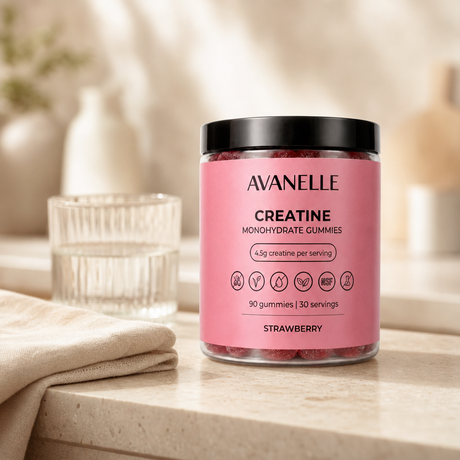
A modest dose you won't skip
Three gummies, 4.5 g of creatine monohydrate, no loading phase. Exactly the steady daily dose this article describes — without the scoop.
- 4.5 g per serving
- No loading needed
- Sugar-free
- Vegan
Who Should Talk to a Doctor First
Anyone being treated for a mental-health condition should involve their prescriber before adding a supplement, both so the plan stays coordinated and so any changes in how you feel are tracked properly. If you have kidney disease or take multiple medications, raise that as well. And if your mood worsens or you have thoughts of self-harm, contact your clinician or a crisis line right away — that is a medical priority, not something a supplement addresses.
FAQ
Can you take creatine with SSRIs?
There is no known pharmacological interaction between creatine and SSRIs, and the combination is generally considered compatible for healthy adults. Tell your prescriber before adding creatine so your treatment stays coordinated.
Does creatine help with depression?
Creatine is not a treatment for depression. Some emerging research, notably in women with major depressive disorder, has studied 5 grams of creatine daily as an add-on to an SSRI with promising results, but this is preliminary, complementary science that needs larger studies — not a medical claim.
Will creatine interfere with my antidepressant?
There is no evidence that creatine reduces an SSRI's effectiveness or changes how it is metabolised. Creatine does not act on serotonin, so it does not carry serotonin-related interaction cautions.
How much creatine was used in the SSRI studies?
The depression-augmentation research generally used 5 grams of creatine monohydrate per day alongside the prescribed antidepressant, taken consistently and without a loading phase.
Can I replace my antidepressant with creatine?
No. Creatine is not a substitute for prescribed treatment. Never start, stop, or change an antidepressant on your own — any change should be made with your prescriber.
Avanelle Creatine Monohydrate Gummies deliver 4.5g of pure creatine monohydrate per 3-gummy serving — sugar-free, vegan, with no artificial colours and no loading required, so a consistent daily dose is simple to maintain. Shop all flavors.
If you are struggling with your mental health, you are not alone — please reach out to your clinician or a local crisis line. In the U.S. you can call or text 988 for the Suicide & Crisis Lifeline.

The dose is easy. The habit is the hard part.
4.5 g of creatine monohydrate in three sugar-free gummies — nothing to measure, nothing to mix, nothing to wash up.
See all options












































