


4 min read
Creatine Before or After Workout? The Research-Backed Answer
Post-workout creatine has a slight edge in the research, but daily consistency matters far more than timing. Creatine works by keeping muscle phosphocreatine stores elevated over time — it is not an acute stimulant like caffeine that produces a performance effect within the same session. Whether you take it before, after, or at a completely unrelated time of day, the long-term outcomes converge as long as you take it every day.
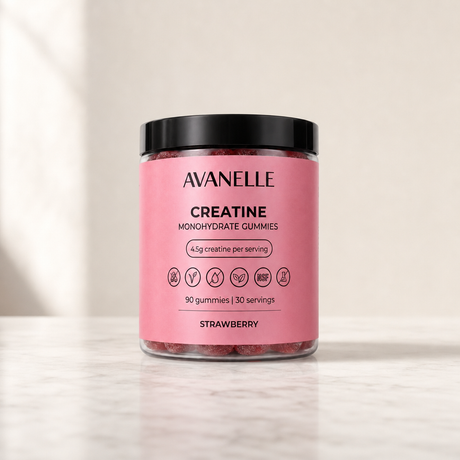
 Three gummies is 4.5 g. No scale, no scoop, no arithmetic.
Does Creatine Timing Actually Matter?
Understanding why timing is a secondary variable requires understanding how creatine works.
Creatine is stored in muscle tissue as phosphocreatine. Your body uses phosphocreatine to rapidly regenerate ATP — the energy currency of muscle contraction — during short, high-intensity efforts: a heavy lift, a sprint, the last few reps of a set. When you supplement creatine, you raise the total amount of phosphocreatine available in your muscles above what diet alone can achieve.
The key word is “stores”. The performance benefit comes from having elevated stores throughout the training session, not from creatine consumed in the hour before it. Full muscle saturation — the state where your phosphocreatine stores are consistently elevated — takes 3–4 weeks of daily supplementation to achieve at a 3–5g maintenance dose. From that point on, the daily dose is simply maintaining stores, not acutely boosting performance in the session you take it.
This is why timing is a second-order concern: once you are saturated, it does not matter whether you take today’s dose at 7am, around training, or at 9pm. You are already operating from a fully loaded baseline.

The Research on Creatine Before vs After Workout
The most cited study on creatine timing (Antonio and Ciccone, 2013) compared two groups over four weeks of resistance training:
- Group 1: 5g creatine immediately before training
- Group 2: 5g creatine immediately after training
The post-workout group showed greater gains in lean mass and strength, though the difference was modest and the study was small (19 participants). The authors noted that the post-workout advantage was statistically significant but that both groups improved substantially compared to their baselines.
A follow-up analysis found that taking creatine close to a workout — before or after, rather than at a distant time like first thing in the morning — was associated with better body composition outcomes than workout-independent timing. This suggests that proximity to training may matter more than the specific pre/post distinction.
Other studies have found no statistically significant difference between pre- and post-workout timing. The research consensus is that timing produces a small, real but not large effect, and that individual factors — meal composition, training intensity, habitual timing — probably influence outcomes more than the pre/post window itself.
Why Post-Workout Has a Slight Edge
The theoretical basis for post-workout creatine is rooted in muscle cell physiology after exercise. Resistance training increases blood flow to muscles and upregulates certain transport proteins, including creatine transporter (CrT), which moves creatine into muscle cells. In the post-exercise window, muscles are in a more receptive state for nutrient uptake generally — the same logic that supports post-workout protein consumption.
Taking creatine alongside a post-workout meal containing both protein and carbohydrates may further enhance uptake. Insulin — released in response to carbohydrate and protein — stimulates creatine transporter activity. This is also why creatine taken with a meal generally stores better than creatine taken alone in a fasted state.
In practice: if you eat a protein-and-carb meal after training anyway, adding creatine to that meal is the path of least friction and aligns with the theoretical post-workout advantage.
The measuring is already done
1.5 g per gummy, three a day, 4.5 g — right in the middle of the researched range. No loading phase, no shaker, nothing to get wrong.
- 1.5 g per gummy
- 3 a day = 4.5 g
- No loading needed
- Sugar-free
The Most Important Factor: Daily Consistency
The research is clear that the dominant variable in creatine supplementation is not timing — it is consistency over weeks and months.
Missing three or four doses per week will reduce your steady-state muscle creatine concentration more significantly than any timing difference between pre- and post-workout. The benefit of creatine is cumulative: stores build up over 3–4 weeks, and the performance and recovery effects compound with consistent training. Inconsistent supplementation undermines both.
This is why format matters practically. A creatine supplement you will actually take every day — including rest days, travel days, and days when you skip the gym — outperforms theoretically optimal timing with poor adherence.
When to Take Creatine on Rest Days
Take it. The same daily dose on rest days as on training days.
Muscle creatine stores are maintained continuously, not acutely boosted before exercise. Stopping on rest days causes gradual store depletion — the same process that happens when you stop supplementing entirely, just slower. Over time, inconsistent rest-day supplementation will lower your steady-state creatine level and reduce the performance benefit.
On rest days, timing is even less relevant. Take it whenever fits your routine — with breakfast, with lunch, in the evening. The only variable that matters is that you take it.
A Practical Guide: Best Time to Take Creatine
If you train in the morning: Take creatine with your post-workout meal. This aligns with the theoretical post-workout advantage and is easy to remember as part of the recovery routine.
If you train in the evening: Take creatine with dinner or a post-workout snack. The post-workout window still applies.
If your training schedule varies: Pick a fixed time of day — with a meal you eat every day — and take it consistently. The timing advantage from proximity to training is smaller than the consistency advantage from never missing a dose.
On rest days: Take it with any meal. The time does not matter.
Avanelle creatine gummies make the daily habit easy — no mixing, no shaker, no pre-workout logistics. Three gummies whenever your routine calls for them, training day or not.

A dose you can't get wrong
Three gummies, 4.5 g of creatine monohydrate, every day. One bottle is 90 gummies — exactly thirty servings.
See all options












































