


4 min read
Does Creatine Make You Gain Weight? The Truth About Water Weight
Creatine makes you gain weight by drawing water into your muscle cells as they absorb it — not by adding fat. In the first one to two weeks, this adds roughly 1–2 lbs (0.5–1 kg) to the scale. Once your muscle creatine stores are full, the weight stabilises and stops rising. It is a sign the creatine is working, and it has no effect on how you look.
 A steady 4.5 g daily dose — three gummies, no loading phase.
Why Does Creatine Make You Gain Weight?
Creatine is stored in your muscles as phosphocreatine. Each gram of creatine stored pulls approximately 3 grams of water into the muscle cell with it. As your muscle creatine stores fill up during the first week or two, water follows. The result is slightly fuller muscles and a modest uptick on the scale.
Once your stores are saturated — typically after 1–2 weeks on a maintenance dose of 3–5 g per day — the scale weight stops rising. You’re not accumulating more water indefinitely; you’ve reached your muscle’s creatine capacity.
How Much Water Weight Does Creatine Add?
Research puts the average initial water weight gain at 1–3 lbs (0.5–1.5 kg) over the first two weeks. Women tend to land at the lower end of that range — closer to 0.5–1 kg — because women typically carry less total muscle mass than men, meaning smaller absolute creatine stores and less retained water overall.
A loading phase (20 g/day for 5–7 days) saturates stores faster and produces a slightly larger initial spike. Skipping loading and going straight to 3–5 g/day produces the same end result over 3–4 weeks, with a gentler rise.
Creatine Weight Gain in the First Week — What to Expect
In the first week, your muscle creatine stores are filling up. Scale weight typically rises by 0.5–1 kg as water follows the creatine into muscle cells. You may also notice slightly fuller muscles and marginally better energy in the later sets of a workout — an early sign that phosphocreatine availability is improving.
By week two, the water weight stabilises. Your stores are approaching saturation, and the daily dose is increasingly maintaining them rather than filling them. The number on the scale stops climbing. Most women are fully saturated by weeks 3–4 at a standard 3–5 g/day dose.
Does Creatine Cause Weight Gain in Women?
Yes, but the amount is smaller than for men. Women typically gain 0.5–1 kg of water weight from creatine in the first two weeks, while men tend to gain 1–1.5 kg. The difference comes down to total muscle mass: women carry less, so the absolute creatine storage capacity — and the water that comes with it — is smaller.
Beyond the initial water weight, creatine does not cause weight gain in women from fat. Studies following women on creatine for 4–12 weeks consistently show no increase in body fat percentage. If anything, women on creatine who resistance train see improved muscle composition compared to controls — more lean mass relative to fat.
For women tracking their weight closely: the 0.5–1 kg increase is water inside muscle cells. It does not change how clothes fit or how you look. It’s simply a new baseline that reflects fuller, better-fuelled muscle tissue.
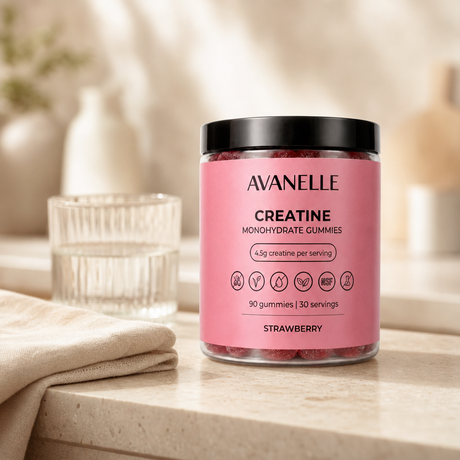
A modest dose you won't skip
Three gummies, 4.5 g of creatine monohydrate, no loading phase. Exactly the steady daily dose this article describes — without the scoop.
- 4.5 g per serving
- No loading needed
- Sugar-free
- Vegan
Is Creatine a Weight Gainer?
No. Creatine is a performance supplement, not a weight gainer. Weight gainer products are designed to deliver large amounts of calories and protein to drive mass gain. Creatine has no calories, does not affect hunger hormones, and does not cause fat accumulation.
The small scale-weight increase from creatine is temporary water weight from intramuscular retention — not the kind of mass gain associated with bulking. If you’re using creatine as part of a training programme, any lean mass gains you see over months come from the improved training output creatine enables, not from the creatine itself.
Is Any of This Weight Fat?
No. Creatine has zero calories, does not affect hunger hormones, and has no impact on fat metabolism. Every pound gained in those first two weeks is water sitting inside your muscle cells, not stored body fat.
Studies following women on creatine for 4–12 weeks consistently show no increase in body fat percentage. What they do show is increased strength output, improved recovery, and in many cases better muscle composition — the opposite of what “weight gain” usually implies.

Does the Water Weight Ever Go Away?
- While you keep taking creatine: The initial water weight stabilises and doesn’t keep rising. After a few weeks most people stop noticing it because it becomes their new baseline.
- If you stop: Creatine stores deplete over 4–6 weeks and the retained water leaves with them. The scale drops back, but so do the performance benefits.
What the Scale Gain Actually Looks Like in Practice
For a woman weighing 65 kg, a 0.5–1 kg rise from creatine represents less than 1.5% of total body weight. It’s invisible to the eye, has no effect on how clothes fit, and doesn’t change how you look. The number on the scale goes up slightly; body composition either stays the same or improves.
The only time to plan around this is if you compete in a weight-class sport where you need to make a specific weight on a set date. In that case, timing your creatine use around the weigh-in is worth discussing with your coach.
The Bottom Line
Creatine causes a real but modest and temporary scale-weight increase from water drawn into muscle tissue. It is not fat gain. It plateaus after 1–2 weeks and is simply your muscles storing more creatine and the water that comes with it.
Want to start creatine without the hassle of mixing powder? Avanelle creatine gummies deliver 4.5 g of creatine monohydrate per serving — no shaker, no measuring, no chalky aftertaste.

The dose is easy. The habit is the hard part.
4.5 g of creatine monohydrate in three sugar-free gummies — nothing to measure, nothing to mix, nothing to wash up.
See all options












































