


brain fog 3 min read
Creatine and Brain Health: What the Research Actually Says
Creatine is stored in the brain as well as in muscles, and it plays a direct role in brain energy production. A 2024 systematic review and meta-analysis in Frontiers in Nutrition found that creatine supplementation significantly improves memory, attention, and information processing speed in healthy adults — with the strongest effects in people who have lower baseline creatine levels, a category that includes most women.
 Three gummies a day — small enough to fit a routine you already have.
Creatine Isn’t Just a Muscle Supplement
Most people know creatine as a gym supplement. What’s less widely understood is that roughly 5% of the body’s creatine is stored in the brain, where it serves the same fundamental function as in muscle: replenishing ATP, the cell’s primary energy currency.
The brain is extraordinarily energy-demanding. Although it accounts for only about 2% of body weight, it consumes approximately 20% of the body’s total energy. Anything that helps maintain ATP availability in brain cells has a real opportunity to influence cognitive performance — particularly during cognitively demanding tasks, high stress, or sleep deprivation.
What the Evidence Shows
Memory and Processing Speed
A 2024 meta-analysis published in Frontiers in Nutrition, which analysed multiple randomised controlled trials in healthy adults, found that creatine supplementation produced significant improvements in memory, with notable effects on information processing speed and attention. A separate 2022 meta-analysis in Nutrition Reviews (Oxford) reached similar conclusions specifically for memory tasks.
Performance Under Sleep Deprivation
One of the more striking findings came from a 2024 study published in Scientific Reports (Nature). Researchers found that a single dose of creatine improved cognitive performance during sleep deprivation and produced measurable increases in high-energy phosphates in the brain on MRI. The implication: creatine helps the brain maintain energy availability even when sleep has depleted it — directly relevant for women dealing with the sleep disruptions common during perimenopause.
Neuroprotection
Beyond acute performance, creatine may have longer-term neuroprotective properties. Research suggests it can mitigate oxidative stress in brain cells, support mitochondrial function, and potentially play a role in resilience against neurological conditions. While this research is earlier-stage, it adds to the case for creatine as a supplement with benefits extending well beyond physical performance.
Why Women May Benefit More
Women have up to 70–80% lower natural creatine stores than men, due to lower average muscle mass and the role oestrogen plays in creatine synthesis. This matters for brain health because lower systemic creatine availability likely means lower brain creatine availability too.
Supplementation has more room to make a difference when starting from a lower baseline. This was borne out in a 2025 randomised controlled trial (CONCRET-MENOPA) in peri- and postmenopausal women, which found that 8 weeks of creatine supplementation produced a measurable increase in frontal brain creatine levels on MRI spectroscopy, alongside improvements in reaction time and mood swing severity.
Research also specifically notes that creatine may reduce information processing time in women, suggesting sex-specific cognitive effects beyond what would be predicted from general population studies.
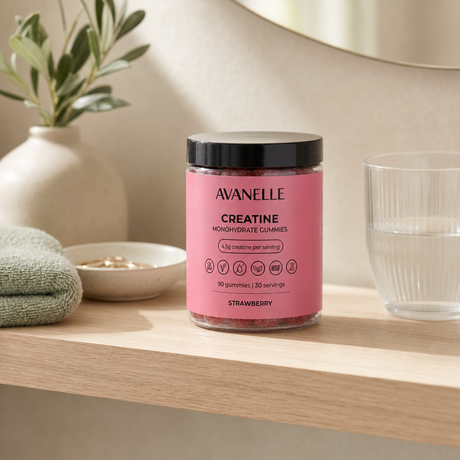
Made to fit the routine, not rearrange it
4.5 g of creatine monohydrate in three gummies, taken whenever suits — with breakfast, with everything else. No mixing and no loading phase.
- 4.5 g per serving
- 3 a day
- Sugar-free
- Vegan
Brain Fog During Perimenopause
Brain fog — that frustrating combination of slow thinking, poor concentration, and memory lapses — is one of the most commonly reported but least discussed symptoms of perimenopause. The mechanism is partly hormonal (oestrogen supports brain energy metabolism), and partly downstream: falling oestrogen reduces creatine synthesis, reducing brain energy availability.
Supplementing creatine during this window addresses one of the contributing factors directly. It won’t resolve all causes of perimenopausal cognitive symptoms, but the evidence increasingly suggests it’s worth including. For more on creatine during this life stage, see our guide on creatine and perimenopause.
How Much and When
The cognitive benefits in research are consistently seen at the standard dose: 3–5 g of creatine monohydrate per day, taken consistently. There is no evidence that a separate “brain protocol” is needed — the dose that saturates muscle creatine stores also raises brain creatine levels over time.
One study did show that a higher single dose (0.35 g per kg body weight, roughly 20–25 g) produced acute cognitive improvements within hours during sleep deprivation — but this is not a recommended daily approach. For daily consistent supplementation, 3–5 g is the evidence-backed target.
The Bottom Line
The evidence that creatine supports cognitive function — particularly memory, processing speed, and performance under mental stress — is now robust enough to take seriously. Women, with lower baseline creatine stores and the additional impact of oestrogen decline, may be among those who benefit most.
The same daily serving of Avanelle creatine gummies that supports your muscles is also delivering creatine to your brain. The dose is the same; the benefits are broader than most people realise.

One more thing in the morning. That's all it asks.
4.5 g of creatine monohydrate, three sugar-free gummies, one bottle a month.
See all options












































